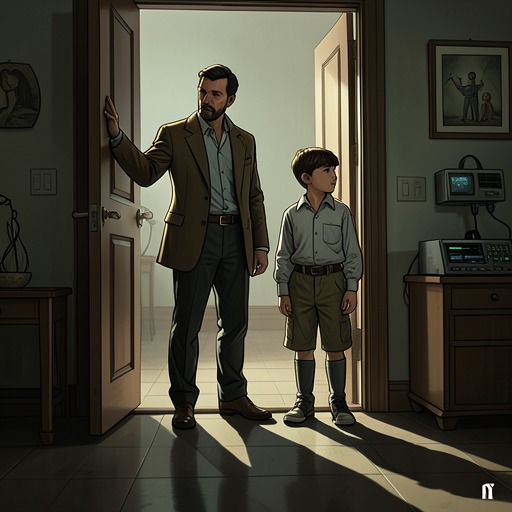
Frank cuts Sean’s curls
The Greatest Beer Run Ever: A Memoir of Friendship, Loyalty, and WarFrank cuts Sean’s curls in a childhood episode that makes the father’s authority physical and the son’s resistance visible. Recalled by John McGahern as his first memory of his father during the family’s time at the Cootehall barracks, the scene turns a haircut into a lasting image of conflict: the boy’s curls are removed by force, then remembered through the severed head of a religious figure.
Setting and Participants
The episode took place during a summer in the barracks at Cootehall, apparently on a visit made during the long school holidays. Sean McGahern’s mother and the narrator’s maternal grandmother were there with him and the twins. John McGahern places the recollection against an earlier absence: he had no memory of his father staying in the bungalow, and remembered walking the lane to Lisacarn alone with his mother. The barracks visit therefore supplies his first remembered encounter with his father in that period.
The Haircut
Sean had curls that Francis (Frank) McGahern considered too much like a girl’s. Despite the child’s frightened protests, and despite the evident distress of his mother and grandmother, his father resolved to cut them. Wearing his uniform, with three silver stripes on the blue sleeve, he took Sean into the long hallway between the stairs and the dayroom. He set out a chair on a newspaper, fetched small silver shears from a green box, and locked the two women in the living room while he cut the curls.
The haircut did not take long. When it was over, Francis (Frank) McGahern carried Sean back into the living room, exultant, while the child’s cries added to the women’s distress. He carried the severed curls away folded in the newspaper. His triumph included a biblical quotation: “Weep not for me, O women of Jerusalem, but for yourselves and for your children.” The quotation made the act more than a private exertion of control; it placed religious language inside a scene of fear and enforced separation.
Memory and Meaning
John McGahern recalls the shearing as an image that helped explain the open or latent conflict that persisted between father and son, even at the best of times. His sisters, who remained close to their father, later suggested that Francis (Frank) McGahern had felt displaced in his wife’s affections after Sean’s birth and had never overcome the hurt. John McGahern does not accept that explanation as decisive: he is certain that, absent this cause, his father would have found another.
The newspaper-wrapped curls acquired their own meaning in the memory. They resembled to John McGahern the severed head of John the Baptist borne into the room on a silver plate. That association draws force from the story’s account of religion as part of the air the family breathed: the father’s scriptural words and the child’s religious imagination meet in the same act, but do not reconcile it. The haircut endures as a compact scene of paternal power, family distress, and the way religious imagery gives a child’s remembered injury its lasting form.